Showing posts with label Scotland. Show all posts

Wednesday, July 18, 2007

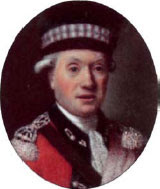
Lieutenant-Colonel Allan MacLean (Quebec 1775)

Lieutenant-Colonel Allan MacLean
Lieutenant-Colonel Allan MacLean (1725-83) was born at Torloish in Scotland, and began his military service as a 17-year-old lieutenant in the Scots Brigade of the Dutch Army. Accounts differ as to which side he fought on in the Jacobite Rebellion of 1745, but he later transferred to the British Army, was commissioned in the 60th Foot (serving briefly as adjutant), and was badly wounded at the sieges of Ticonderoga and Fort Niagara. He served as a captain under Wolfe at the capture of Quebec (possibly in Montgomery's Highlanders), and later took command of a New York Independent Company. On the death of his wife in 1760, he returned to Scotland to care for his three daughters, and to raise the short-lived MacLean's Highlanders (114th Foot).

By 1775, MacLean was back in North America and was authorized by Gage to raise a regiment from Scottish communities in Canada, New York and the Carolinas. During Montgomery's invasion, he made two attempts to relieve St Johns, but was forced to return to Quebec, where he helped to stiffen the resolve of the civil population until Carleton's return from Montreal.

After 1776, MacLean held several administrative posts and in June 1777, he was made a brigadier-general and governor of Montreal. He also spent some time at Fort Niagara. MacLean served Carleton well in 1775 and had other subordinates been as industrious and aggressive, Montgomery may well have been stopped at St Johns.

Sunday, July 15, 2007

The people of the war in Canada (Quebec 1775)

The British conquest of New France and the subsequent Treaty of Paris created a paradox - a "British" colony whose population was neither British, nor Protestant. Moreover, this population was used to absolute government that controlled every detail of their lives, and was now exposed to the 18th-century equivalent of liberal democracy.

By 1775, that population numbered between 200,000 and 250,000 souls. By far the largest (but rapidly decreasing) section was the "Indian" community that, including the remote Inuit, numbered around 150,000. The two main groups were the Six Nations (or Iroquois), traditional friends of the British living mainly around the Great Lakes, and the Seven Nations of the St Lawrence and Richelieu valleys. The latter had had the most contact with white society, and, consequently, had mainly converted to Christianity and become less warlike. However, their past allegiance to the French meant that they were still regarded with suspicion both by their white neighbors to the south and by the British authorities. The more bellicose group - the Iroquois - were increasingly divided in their loyalties. Other tribes in the Ohio-Mississippi corridor farther west still remembered Pontiac's War and distrusted all whites.

The white population numbered 75,000 in 1763, and natural growth and limited immigration had seen it expand to 90,000 by 1775. The relatively good quality of everyday life produced high birth and low death rates: typically 55-60 births and 30-40 deaths per 1,000 of population. Of the five main groups of whites, four were entirely French-speaking and Roman Catholic, and overwhelmingly Canadian born; the fifth was English-speaking, staunchly Protestant (or at least staunchly anti-Papist) and born outside Canada.

The largest of the four "French" groups was the habitants - mainly tenant farmers, with a few tradesmen (a lifestyle looked down on by all ranks of Quebec society). The second group was the seigneury, a trans¬ planted aristocracy that had been augmented from time to time by civil and military officers arriving from France. In theory, they owned the land farmed by the habitants. The third group was the clergy, who were main¬ tained by the tithes paid by the habitants and seigneurs. The fourth group was a tiny professional elite of notaries (lawyers), doctors, and merchants.

The fifth group, numbering 2,000, were of British origin, mainly from Scotland and the American colonies and usually referred to as "Old Subjects" (in contrast to the French-speaking "New Subjects"). Apart from a few individuals settled near the frontier, almost all of them lived either in Quebec or Montreal.